Showing posts with label Photography. Show all posts

Canon EOS 7D Mark II PERFORMANCE AND CONCLUSIONS

Friday, January 2, 2015

Canon EOS 7D Mark II
The 7D Mark II starts and captures an in-focus image in just about half a second, and it locked focus speedily in a variety of lighting scenarios. Our standard focus speed test involves shooting an analog stopwatch on an LCD display, and the 7D consistently locked focus and fired in about 0.05 second. Doing the same with Live View enabled only extended that time to 0.1 second, with a mere 0.4 second required if the EF-S 18-135mm f/3.5-5.6 IS STM lens was significantly out of focus before the shutter was pressed. In low light the 7D slows to about 0.8 second to acquire focus and fire a shot—that’s really quick.

Canon EOS 7D Mark II
The 7D’s focus system features 65 AF points, all of which are cross-type. The focus system can be set to choose a point or points automatically from the entirety of its area or do the same from one of three zones (left, center, and right), or you can select from a point or group of five to 15 points. When set to direct control, it’s very quick to change between focus modes and move the active point around. And, unlike less-expensive cameras, the 65 points cover almost the entire frame. Like Canon’s full-frame flagship camera, the EOS-1DX, the 7D Mark II features an autofocus system that you can adjust to your heart’s content. It has six main customizable modes to choose from, each corresponding to a different type of scene.

Canon rates the 7D at 10 frames per second (fps), and it just about lives up to that claim, hitting 9.8fps over full bursts of shots in our lab tests, even with AI Servo continuous focus enabled. Depending on the format you’re shooting, the number of images you can capture in a burst varies. In Raw+JPEG mode it manages 18 shots before slowing down; it can keep shooting at a slower pace, but if you want to clear all of those images to a memory card and start with a fresh buffer, only about 7.6 seconds is required. If you use Raw mode, the buffer holds about 26 shots before the 7D slows, with a short 6.4 seconds required to clear all of those images. But when I opted to shoot JPEG, I held the shutter button down for a full 2 minutes, capturing more than 1,200 full-resolution images with no signs of the 7D slowing down. That’s pretty amazing.

Canon EOS 7D Mark II
I used Imatest to check and see how the 7D Mark II’s image quality holds up at higher ISOs. When shooting JPEGs at default noise reduction settings the camera keeps noise under 1.5 percent through ISO 3200. Minor smudging became noticeable at ISO 3200, but images are very crisp at ISO 1600 and below; detail drops off further at ISO 12800 and the top standard setting, ISO 16000, but both should be fine for Web use. Raw images show strong detail through ISO 25600, although there’s a lot of grain.

The 7D Mark II records QuickTime or MP4 video at up to 1080p60 quality. You can only record footage at 1080p60 using an IPB compression scheme, which is more heavily compressed than the ALL-I recording options available at 1080p30, 1080p24, and 720p60. If you plan on shooting video with the intention of editing it into a finished project, ALL-I is the way to go. The camera features both a microphone
input port and a headphone jack, so you can connect a pro-grade microphone and monitor audio while recording. Video quality is excellent, with sharp details, but as with most large-sensor cameras, rolling shutter can be an issue when panning quickly or capturing fast-moving action. Video autofocus is very quick, as on-sensor phase detection handles all of the work. The 7D can also be set for Servo AF, which constantly adjusts focus as the scene changes, though this feature is disabled when shooting at 1080p60. Autofocus modes available when recording video include face detection with tracking, a wide focus area, and an adjustable flexible spot.

The 7D Mark II has a number of interface ports. It uses USB 3.0 for data and it has a mini HDMI output to send uncompressed video footage to a field recorder. There’s also a remote control port and a PC sync socket to connect to studio strobes. It supports two memory cards, one CompactFlash and one SD, SDHC, or SDXC.

Owners of the original 7D have been patiently waiting for an updated camera. The 7D Mark II proves that the wait was worth it. It has the best autofocus system that I’ve seen in an APS-C body, and its image quality holds up against the stiff competition in this category. When you add in smooth autofocus when recording video or using Live View for stills and access to Canon’s extensive lens system, you have a camera that is worthy of being called our Editors’ Choice.

Canon EOS 7D Mark II Review

Monday, December 29, 2014

Canon EOS 7D Mark II
Sharpen Your Focus With all new EOS 7D Mark II Canon D-SLR, a successor to the APS-C D-SLR, the 7D. comes with 65-point autofocus system runs circles around the original 7D’s 19-point system, and on-sensor phase detection vastly improves autofocus speed when recording video. There are some drawbacks; it doesn’t have an articulating rear display or integrated Wi-Fi like the less expensive Sony Alpha 77 II. But the 7D Mark II is a killer SLR that action shooters and videographers should take a close look at.

As you’d expect from an SLR that’s positioned at the top of its class, the 7D Mark II features a big, bright optical viewfinder with 100 percent frame coverage. A black outline shows the area covered by the 7D’s autofocus system that lights up in red when the focus system is engaged. The active focus point is also displayed in the OVF, as is a digital level, and icons that let you know when the auto focus system is engaged and when you’re shooting under flickering lights. Shooting information is displayed via a green LCD that runs across the bottom and along the right side of the finder.

WHEN DENSITY CALLS
The rear LCD on the Canon EOS 
7D Mark II isn’t hinged, but its 
1,040k-dot resolution makes 
it look incredibly sharp.

DESIGN AND FEATURES

 7D Mark II
 7D Mark II
INTERFACE READY
A number of interface ports let you 
easily get your data from the 7D 
Mark II; there’s even support 
for two memory cards.

The 7D Mark II is as big as some smaller full-frame bodies, measuring 4.4-inch x 5.9-inch x 3.1-inch and weighing 2 pounds. Its 1/8,000-second shutter is rated to 200,000 cycles and the body is sealed to protect it from dust and water. The result is an extremely durable body that feels a lot more solid than the company’s entry-level full-frame offering, the EOS 6D.

Some design choices had to be made to achieve the durability the 7D Mark II promises. The rear 1,040k-dot-resolution LCD is a fixed panel, which isn’t quite as useful for video as the vari-angle display that Canon uses in the midrange 70D, and the magnesium alloy chassis means that there’s no built-in Wi-Fi, as an all-metal build interferes with wireless data transmission. That didn’t stop Canon from including a GPS module, which adds location data to images when enabled; Sony went the opposite route with its Alpha 77 II, omitting a GPS and including Wi-Fi, as well as a hinge-mounted display.

Canon EOS 7D Mark II PERFORMANCE AND CONCLUSIONS

PROS
  • 10fps continuous shooting. 
  • 65-point cross-type autofocus system. 
  • Good control layout.
  • Huge JPEG shooting buffer. 
  • Lots of detail at high ISO.
  • Access to Canon lens system.
  • 1/8,000-second shutter. 
  • Integrated GPS. 
  • CompactFlash, SD card slots. 
  • Shoots 1080p60 video. 

CONS
  • Pricey. 
  • Lacks built-in Wi-Fi. 
  • Fixed rear LCD. 
  • Servo AF unavailable when shooting at 1080p60. 


Sunpak DigiFlash 3000

Sunpak DigiFlash 3000
A brighter idea for your DSLR camera. The very capable Sunpak DigiFlash for DSLR cameras offers all the power you need, with the features professional photographers demand. With complete TTL compatibility for your Canon or Nikon DSLR camera, the DigiFlash 3000 is perfect for portraits, groups, sporting events and stage productions. And it packs more flash power than your DSLR’s built-in flash, so you can capture perfect moments using longer zooms, for stunning results. And no more running out of flash power when you need it. 

The DigiFlash 3000 is loaded with professional features, such as a bounce and swivel head for the ultimate in lighting control and creativity. To customiz e-flash coverage, its built-in manual zoom head matches any 18 mm to 70 mm DSLR lens. And with a low light autofocus assist, you won’t miss another shot when light is poor.

Big on power and high on features, the DigiFlash 3000 delivers what you need, at a fraction of the price of a comparable camera-brand flash.

Samsung NX1 SMART CAMERA Overview

Sunday, December 28, 2014

Samsung NX1 SMART CAMERA
Once again Samsung comes with the new Samsung NX1 SMART CAMERA with UHD 4K video.

Special Features

Explore a whole new dimension of detail with stunning 4K video, 28 megapixel BSI CMOS sensor and continuous AF shooting at 15fps, the Samsung NX1 lets you make your mark.

Pentax 645Z Review

Friday, December 26, 2014

PENTAX 645Z
RICOH IMAGING’S PENTAX 645Z is a “medium format” digital camera with a 43.8x32.8mm CMOS sensor, 1.66 times the size of a standard full-frame sensor. The sensor features a very high resolution of 51.4MP (8265x6192 pixels) and can record in JPEG and in Pentax’s own Raw (PEF) or Adobe DNG format.

The Pentax 645Z has a massive and robust sealed body. The large sensor, the large mirror box, and the large pentaprism for the optical viewfinder require a lot of space, thus the fairly bulky design. Despite this, the camera is very handy. A large grip on the right- hand side allows the user to hold the camera comfortably. Numerous function buttons and setup dials make it easy to change image parameters while holding the camera in its shooting position. And, for images taken in portrait format, the camera offers a 3/8-inch tripod socket on its left-hand side. It should be very easy for Pentax photographers to handle the new 645Z as the setup and the menu structure are very similar to Pentax K-series cameras.

The camera has a large and bright viewfinder, which offers full control of the image. Manual focusing is easy, plus there’s a handy swivel monitor. In addition, the 645Z is the first medium format camera that delivers video recording, with Full HD capability.

COMMENTS ON IMAGE QUALITY

COLOR:
The Pentax 645Z showed a very good reproduction of our color test chart. It was reproduced with nearly perfect saturation (98.2 percent). The automatic white balance system created a minor shift of brighter nuances into the yellow area, but this effect is quite insignificant. The color errors are on a very low level. Skin tones are reproduced very naturally and all other colors show no or only minor aberrations.

SHARPNESS:
The Pentax 645Z created images with a sharp and crisp look, but doesn’t deliver entirely on its nominal sensor resolution of 6,192 lines per picture height. However, the maximum result of 5,671 lines per picture height is still extremely high and can yield large format prints and even crops with rich detail. The shots have a very natural-looking sharpness and don’t show typical sharpness filtering artifacts like contours on contrast lines.

NOISE:
The Pentax 645Z uses a 43.8x32.8mm sensor with 51.4MP with a pixel size of 5.3 microns. This is similar to the pixel size of the Phase One IQ250 digital back and the Hasselblad H5D-50c, which use a different sensor. The pixel size combined with CMOS technology allows the user to shoot with higher ISO speed ratings than with former CCD digital backs. The Pentax 645Z has a high ISO rating of 208,400, but this extreme ISO isn’t recommended because the camera shows extreme luminance and color noise artifacts in the images. However, the noise results are very good at lower ISO speed settings. Between ISO 100 and 3200 they are a little bit higher than in images taken with full-frame sensor cameras made by Canon, Nikon, and Sony, but are still on a very good level.

The Pentax 645Z achieved high results in our dynamic range test. The maximum of 12.3 f/stops is an extremely good result, and this is maintained in the ISO 100 to ISO 6400 range. At higher settings it drops significantly: at settings higher than 51,200 it declines to less then 8 f/stops.

COMMENTS ON VIDEO FUNCTIONS

PENTAX 645Z
The Pentax 645Z is the first medium format camera that allows the user to shoot video clips. The camera takes videos with a resolution of 1920x1080 pixels up to 30 frames per second in progressive mode. In addition, it offers two modes with 50 or 60 interlaced frames. The camera saves video as Apple QuickTime MOV files with H.264 compression, but only at 24 Mbit/s, which is lower than the data rate Canon is using for its SLR videos. It can shoot videos in all exposure modes, so a manual setup of aperture size, shutter speed, and ISO speed setting is available. The ISO speed is limited to ISO 3200.

Video handling is easy: 
The camera has a mode switch on the back (to the right of the viewfinder) that allows the user to toggle between photo and video mode. The live view button (a small red dot) on the back can be used as an additional shutter release button for recording video. The camera allows for contrast metering to set up focus in live preview mode, but is unable to focus while recording the sequence. It also offers a very special kind of 4K recording: these are extremely short sequences (two seconds) in a time interval mode, quite useful for time-lapse recordings.


COMMENTS ON VIDEO QUALITY

The video quality is noticeably lower than the superb still image quality. The downsampling of the extremely high-resolution sensor to the 2MP resolution of the Full HD videos causes some serious problems. Our test sample video shows that the Pentax 645Z takes videos with a lot of aliasing and moiré effects. Contrast lines and fine structures show intense flickering. The overall look of the video is very soft and even blurred. The resolution test result also reinforces our clip tests. The Pentax reproduced the ISO 12.233 chart with 399 lines per picture height, which is remarkably low. 

The color reproduction is good: there are only minor noticeable errors. The test sample shows that the camera tends to create video images with very high contrast and therefore emphasized colors. The reproduction of bright to dark gradations is quite “hard.” The camera achieved a maximum of only 6.13 f/stops in video mode, while it is able to record still images with up to 12.3 f/stops.

PRO
  • Professional medium format system with a lot of current camera features
  • Very large and bright optical viewfinder with 100 percent field of view
  • Very high-resolution still images
  • Realistic color reproduction
  • Fast AF system
  • Easy handling
  • Swivel monitor


CON
  • Disappointing video results
  • Massive camera body

Canon EOS DSLR for Beginners, Experienced Amateurs, and Professionals

Monday, December 9, 2013


EOS for Beginners, Experienced Amateurs, and Professionals.


The Canon EOS DSLR system includes cameras, lenses, and accessories for every user level – from beginners, experienced amateurs, and professionals.


Entry-level EOS DSLR Cameras


Canon EOS 1100D

Your first DSLR, Easy to use, and Available in four colors.


The EOS 1100D is specifically developed with the needs of users purchasing their first DSLR in mind, in addition to photographs, the Camera can shoot HD videos. Bundled with EF-S 18-55mm F/3.5 – 5.6 IS II lens and featuring 12.2 – megapixel CMOS sensor, ISO up to 6400, 3 frame per second, EOS Movie HD, and come equipped with DIGIC 4 imaging processor.

Canon EOS 100D

World's Smallest and Lightest APS-C DSLR and Touch-screen.


The compact EOS 100D is a perfect choice for anyone who wants a small and lightweight DSLR. The camera has a new 18-megapixel hybrid CMOS sensor and touch-screen LCD. Also, it comes featuring 12,800 ISO for still image and 6400 ISO for video recording, upto 4 frames per second, DIGIC 5 imaging processor, ratio of 3:2 3-inch  ClearView II LCD, and EOS Movie Full HD. It ship with EF-S 18-55mm F/3.5 – 5.6 IS STM lens.

Canon EOS 600D

Vari-angle LCD!


A small but versatile camera suitable for many kinds of users. The vari-angle LCD is handy for shooting both photographs and Full HD movies. It comes equipped with EF-S 18-55mm F/3.5 – 5.6 IS II lens or EF-S 18-135 F/3.5 – 5.6 IS lens. Also, it featuring 18-megapixel CMOS sensor, 6400 ISO, 3.7 frames per second, DIGIC 4 imaging processor, ratio 3:2 3-inch tilted LCD and EOS Movie Full HD.

Canon EOS 700D

Vari-Angle touch-screen!


A great choice for a wide range of user. Vari-angle touch-screen LCD and advanced features like hybrid  CMOS AF provide smooth and quiet focus with STM lenses. Upon opening it partner with EF-S 18-55mm F/3.5 – 5.6 IS STM lens or EF-S 18-135mm F/3.5 – 5.6 IS STM lens. Also, itfeaturing 12,800 ISO for still image and 6400 ISO for video recording, upto 5 frames per second, DIGIC 5 imaging processor, ratio of 3:2 3-inch  ClearView II LCD, and EOS Movie Full HD.

EOS M – the mirrorless alternative

Easy to take along anywhere!


The Canon EOS M is a stylish and compact camera with interchangeable lenses. The EOS M is much smaller and lighter that other EOS cameras and a perfect choice for everyone who wants a compact system camera with great image quality to shoot still images and Full HD movies with. Available in four colors.


It's featuring 18-megapixel CMOS sensor, 12,800 ISO for still image and 6400 ISO for video recording, upto 5 frames per second, DIGIC 5 imaging processor, and ratio of 3:2 3-inch  ClearView II LCD.

EOS M Lenses

Canon has launch EF-M lenses for EOS M camera and the optional Mount Adapter EF-EOS M makes the camera compatible with EF and EF-S lenses.

It comes available with EF-M 18-55mm STM lens for black, silver, white, or red. While EF-M 22mm STM lens and EF-Mount adaptor and EF-M 18-55mm STM and EF-M 22mm STM lenese and speedlite 90EX Flash comes only with black or white color.

EOS for Enthusiasts and Semi-professionals


Canon 60D DSLR

Vari-angle LCD!


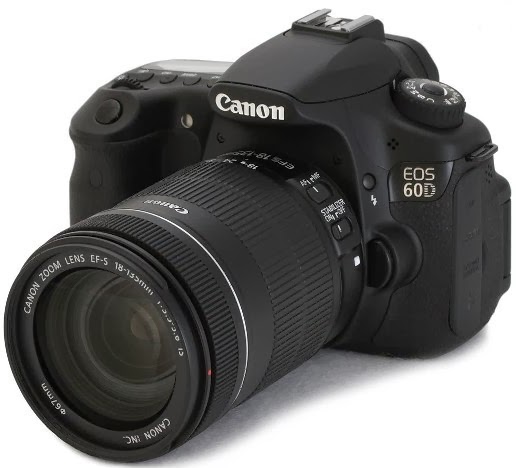
A fast versatile camera designed for advanced amateurs. The large vari-angle LCD monitor is handy, for example when shooting Full HD movies. First, mid-range EOS DSLR to offer in camera Raw processing. It characterize 18-megapixel CMOS sensor, 6400 ISO, 5.3 Frames per second, DIGIC 4 image processor, and ratio 3:2 wide 3-inch LCD. Bundled with EF-S 18 – 55mm F/3.5 – 5.6 IS lens or EF-S 18 – 135mm F/3.5 – 5.6 IS lens.

EOS 70D SLR Camera 

New model with Vari-angle Touch-screen, wi-fi, smooth AF in movie mode.


The EOS 70D is a powerful camera which has many advanced features like WiFi connectivity with smartphones for remote shooting, new Dual Pixel AF technology delivering smaooth focus when shooting movies, 19 croos-type AF point and 7 creative filters for fun shooting. It parceled with EF-S 18-55mm F/3.5 – 5.6 IS STM lens or EF-S 18-135mm F/3.5 – 5.6 IS STM lens.

It featuring 20.2-megapixel CMOS sensor, 12,800 ISO for still image and 6400 ISO for video recording, upto 5 frames per second, DIGIC 5+ imaging processor, ratio of 3:2 3-inch  ClearView II LCD, Dual Pixel CMOS AF and WiFi connectivity with smartphone.

EOS 7D

8 frames per second continues shooting!


A versatile, sturdy, and fast camera, well – suited for advanced amateurs and professionals alike. The optical viewfinder covers 100% of the image area. Compact Flash memory card. 

It featuring 18-megapixel CMOS sensor, 6400 ISO, 8 Frames per second, DIGIC 4 image processor, and ratio 3:2 wide 3-inch LCD. And bundled with EF-S 15 – 85mm F/3.5 – 5.6 IS USM lens or EF-S 18 – 135mm F/3.5 – 5.6 IS lens.

EOS 6D

Smallest full frame EOS DSLR WiFi and GPS camera!


A full frame camera that is compact and lightweight with excellent images quality and extensive connectivity. Advanced features like built-in Wi-Fi, GPS, HDR, and multiple exposure mode. 

It featuring 20.2-megapixel CMOS sensor, 25600 ISO for still image and 12800 ISO for video recording, upto 4.5 frames per second, DIGIC 5+ imaging processor, ratio of 3:2 3-inch  ClearView LCD, Ful;l Frame CMOS and WiFi. An EF 24-105mm F/4L IS USM lens or EF 24-70mm F/4L IS USM lens bundled with.

EOS for Professionals


EOS 5D Mark III

Full-frame, 61 point auto focus!


A full-frame camera for professionals and advanced amatuers. Smaller and lighter than the EOS-1DX. 61 point High Density Reticular AF and iFCL Metering with 63-zone dual-layer metering sensor. Compact flash and SD or SDHC or SDXC memory card compatible.

Full-frame, 61 point auto focus EOS 5D Mark III featuring 22.3-megapixel CMOS, 25600 still image ISO, 12800 movie ISO, upto 6 frames per seconds, DIGIC 5+ imaging processor,  ratio of 3:2 3.2-inch  ClearView II LCD, and Full Frame CMOS. An EF 24-105mm F/4L IS USM lens or EF 24-70mm F/4L IS USM lens parcel with.

EOS-1D X

Full-frame continuous shooting 12 – 14 frames per second!


The EOS-1D X with the full-frame 18.1-megapixel sensor, fast AF, and extensive ISO range meets the needs of all kinds of professional photographers and film-makers.

61-point High Density Reticular AF and EOS Intelligent Subject Analysis (iSA). Weather-sealed magnesium alloy body. Holds two compact flash cards.

EOS-1D X featuring 18.1-megapixel CMOS sensor, 51200 ISO for still image, 25600 ISO for movie record, upto 12 frames per second, equipped with DIGIC 5+ imaging processor, ratio of 3:2 wide 8.1cm or 3.2-inch ClearView II LCD and Full Frame CMOS.

Delighting You Always Better Images and Videos with Canon EOS System


Better Images and Videos with Canon EOS System


Unleashed your creativity! Pick the right lenses for anything you want to shoot! Family, Action, Hobbies Portraits, Weddings, Travel, Landscapes, Interiors, Sports, Nature, Pets, Wildlife, Events, Macro, and Video.


Your chances of capturing better image grow with every new lenses. The Canon EF and EF-S lens system has the right lens for every shooting situation and for all kinds of photographers – amateurs, enthusiasts, semi-professional and professionals.

By choosing a Canon EOS DSLR camera you can be sure that you will always find a camera and a set of lenses suited for your needs.

From Beginners to Professionals

The Canon EOS system includes cameras, lenses, and accessories for every user level – for beginners, experienced amateurs, and professionals. The EOS system is easy to expand as your skills develop. New lenses and accessories will open the door to a new world of choices.

Fast Operation and High Quality Images

With Canon EOS everything works fast – startup, operation, and autofucos. Using the proprietary Canon sensors and processing technologies the EOS cameras are always able to help you capture top-quality pictures, even in difficult situations and conditons.

Easy to Use

A beginner will appreciate the fact that all entry-level EOS cameras can be used in a fully automatic mode in which the camera takes care of the settings. All you need to do is point the camera at the target, frame the image, focus, and press the shutter button. In the consumer models you also have a set of easy -to-use shooting modes designed for portraits, landscapes, sports, close-ups, and many other shooting situations.

Full Manual Control Available to All Users

Of course, all the advanced exposure control modes you need for creative photography are available in all EOS models. As you get more into photography, you can start using aperture-proirity and shutter-proirity modes, and finally you can shoot like a pro by using full manual mode to have complete control of every aspect of the exposure.

EOS DSLR Canon Digital Camera Accessories


EOS DSLR Accessories


Speedlite flashguns, Extenders, Close-up Lenses, Extension Tubes, Lens Hoods, Tripod Mounts and Other Accessories


Canon Speedlite flashguns

Canon offers EOS photographers a wide range of Speedlite flashguns. Beginners can add light to thir photos with the affordable Speedlite 270EX II or with the Speedlite 320EX.

The more advanced photographer will find a right tool for every shoot by using the Speedlite 430EX II of the flagship model, the Speedlite 600EX-RT which built-in radio triggering in addition to normal infrared control.

For macro photography you can choose the Macro Twin Lite MT-24EX and the Macro Ring Lite MR-14EX.

Extenders

The focal length of several top EF lenses can be extended by using extenders, which multiply the effective focal length by either 1.4 or 2 times. Extenders are attached between the camera body and the lens.

Canon Extender EF 1.4x III

The Canon Extender EF 1.4x III which increases the lens focal length by 1.4. Effective aperture is reduced by one f-stop. If the maximum aperture of the lens is normally F/2.8, when using the extender it becomes F/4.

Canon Extender EF 2x III

The Canon Extender EF 2x III doubles the focal length. Effective aperture is reduced by two F-Stops.

Close-up Lenses and Extension Tubes

If you want to shoot close-up occasionally, close-up lenses and extension tubes are a cost effective solution.

Close-up lenses 250D and 500D

The Close-up lenses 250D and 500D are attached to the filter thread of the lens and work as a magnifying glass in front of the lens.

Extension tubes EF 12II and EF 25II

The Extension tubes EF 12II and EF 25II extend the distance between the lens and the camera body, which reduces the minimum focus distance of the lens. The longer the extension tube and the shorter the focal length of the lens, the greater the enlargement.

Lens Hoods

A lens hood reduces the possibility of flare, adds contrast to your photos, and protects the front elements of the lens. All the Canon L series lenses with a lens hood and for all the other Canon lenses they are available as accessories.


Battery Grips

Battery grips let you fit two batteries in your camera doubling the number of shots you can take. Vertical battery grips also make handling the camera easier, especially with larger lenses or when you rotate the camera for portraits.

Battery Grips model for every Canon EOS or Canon Rebel

BG-e4 Battery Grip for Canon EOS 5D
BG-E5 Battery Grip for Canon EOS 500D, 450D, and 1000D
BG-E6 Battery Grip for Canon EOS 5D Mark II
BG-E7 Battery Grip for Canon EOS 7D
BG-E8 Battery Grip for Canon EOS 600D and 550D
BG-E9 Battery Grip for Canon EOS 60D
BG-E11 Battery Grip for Canon EOS 5D Mark III
BG-E13 Battery Grip for Canon Canon EOS 6D
BG-E14 Battery Grip for Canon EOS 70D

Remote Controllers

Remote controllers let you release the shutter and operate your camera remotely, either by a cable or wirelessly.

Timer Remote Controller TC-80N3
Remote Switch RS-80N3
Remote Switch RS-60E3
Wireless Remote Controller RC-6
Wireless Controller LC-5

GPS Receivers

GPS Receiver provide photographers with a solution for adding geographical coordinates to thier images and videos.

GP-E1 for EOS 1DX and GP-E2 for EOS 1D X, 5D Mark III, 7D, 6D, and EOS M.

Wireless Transmitters

Wireless File Transmitter provide EOS users with a range of wireless connectivity options.

WFT-E4D for EOS 5D Mark II
WFT-E5D for EOS 7D
WFT-E6D for EOS 1D X
WFT-E7D for EOS 5D Mark III
ST-E3-RT Speedlite Transmitter

Tripod Mounts and Other Accessories

Canon has a wide selection of traditional accessories, from tripod mounts for supporting the telephoto lenses, to filter, adapters, eye caps, cases, straps, and more other. Ask your dealer about it!

EOS Digital Trinity Inspired Many Photographers

Sunday, December 8, 2013


Stuff’s Inspired Many Photographers
 

All EOS cameras offer the options to shoot high definition movies in addition to photographs. And also you can used EOS cameras like camcorders but with better results.

The movie mode in EOS cameras have inspired many photographers to start shooting movies. With EOS 1100D you can shoot movies in HD (720p) resolution and all other EOS cameras offers full HD (1080p) resolution. However, in an absence of EOS Digital Trinity this exceptional creations wont work.

EOS Digital Trinity


The core parts behind the success of the Canon EOS System are the sensors and processor used in the camera and high quality materials used in the camera and lenses. All EOS cameras and Canon lenses rely on proprietary Canon technologies.


CMOS Sensors

EOS cameras use large, high quality CMOS sensors. The sensor receives light through lens and relays it to the processor as an image signal. The CMOS sensors developed and manufactured by Canon ensure high resolution and excellent image quality even at high ISO settings in both consumer and professional models. Sensors come in two sizes, APS-C sensors are used for consumer models and EOS M and full frame sensors are used for pro-level EOS cameras.

Digic Processors
Another key factor when producing images of high technical quality is a processor. All EOS cameras use one or more DIGIC image processor, developed by Canon, to process the data captures by the sensor, enhancing the image quality and producing natural color reproduction and low noise in images. The processor also guarantees high – speed operations in the camera. Most EOS cameras have one DIGIC processor, but certain models have multiple DIGIC processor to guarantee even faster operations.

Canon Lenses

The third element of Canon's digital trinity are the lenses as, Prime Lenses, Zoom Lenses, and Canon Special Lenses. The Canon lens ranges now includes some 80 lenses, varying from ultra-wide fish eye to the super telephoto lenses. Canon's commitment to lens development can be seen in the constant flow of lenses with new kind of specialized elements, coating, and images stabilization technologies. All this makes capturing world class images easier for every EOS camera user.

Canon Special Lenses for Macro, Architectural, and Product photography


Lenses for Macro, Architectural, and Product photography


Macro lenses

Macro lenses allow you to capture stunning life-size images of small details, like insects and flowers. Macro lenses includes;

EF 50mm F2.5 Compact Macro

An affordable macro lens with ½ life size image reproduction. Filter size 52mm.

MP-E 65mm F2.8 1-5X Macro Photo

A special – purpose lens with up to 5X life size magnifications. Filter size 58mm.

EF-S 60mm F2.8 macro USM

An affordable lightweight macro lens for EF-S mount. Filter size 52mm.

EF 100mm F2.8L IS USM

A professional quality macro and portrait lens with IS. Filter size 67mm.

EF 180mm F3.5L USM

A telephoto macro for close-ups from further away. Filter size 72mm.

Canon's Tilt-Shift lenses

TS-E lenses allow creative control of depth of field and perspective. They are widely used for example in architectural and product photography.

TS-E 17mm F4L

Ultra-wide lens. A great choice for architectural photography, especially interiors with tight spaces. Independent tilt and shift movements. Filter holder.

TS-E 24mm F3.5L II

Versatile TS-E lens with independent tilt and shift movements. Great for photographing architectural and landscapes. Filter size 82mm.

TS-E 45mm F2.8

Ideal lens for obtaining a natural perspective for example in nature, outdoor, and commercial studio photography, and creative portraiture. Filter size 72mm.

TS-E 90mm F2.8

A short telephoto TS-E lens suitable for product, food, portrait, and close-up photography, when greater shooting distance is needed. Filter size 58mm.


Canon Prime Lenses – for the best image quality


Canon Prime Lenses - Wide angle, Standard and Medium Telephoto, and Telephoto and Super Lenses


Canon Wide angle lenses

Wide angle prime lenses are excellent choices for landscape photography. They allow you to capture wide vistas where everything, even in the distance is sharp. Wide maximum aperture makes them great lenses for anyone interested in interior and low light photography and movie shooting. Wide angle lenses includes;

EF 20mm F2.8 USM

F/2.8 wide-angle lens having filter size of 72mm and featuring ultrasonic, great for video and landscapes.

EF 24mm F2.8 IS USM

EF 24mm F2.8 IS USM has filter size of 58mm with four stop IS featuring ultrasonic image stabilizer. This type was made for all purpose use.

EF 35mm F1.4L USM

 A high quality F/14 aperture lens, quick and quiet focusing with a filter size of 72mm also ultrasonic.

EF 14mm F2.8L II USM

A highest professional quality ultra wide-angle lens with filter holder.

Canon Standard and Medium Telephoto lenses

Standard and medium telephoto lenses allow you to capture images with natural angle of view. All of the Canon lenses in this category have a fast maximum aperture from F/1.2 to F/2.8. This allows to capture beautiful portraits with shallow depths of field and blurred backdrop and makes them great choices also for low light photography and movie shooting.

EF 40mm F2.8 STM

An F/2.8 pancake lens with a stepping motor (STM) for smooth and quiet focusing. It comes with filter size of 52 mm.

EF 50mm F1.8 II

A compact F/1.8 lens with unbelievable price quality ratio. Ships with a filter size of 52mm.

EF 50mm F/1.4 USM

Fast F/1.4 aperture lens featuring ultrasonic with rapid focusing and filter size 58mm.

EF 85mm F1.2L II USM

Highest professional quality featuring ultrasonic. F/1.2 allows extremely shallow depth of field and securing filter size of 72mm.

Canon Telephoto and Super Lenses

Telephoto and Super Telephoto Lenses have a long focal length and with them you can capture close-ups of far away subjects. Super telephoto lenses are mainly used by nature, wildlife, and sports photography enthusiast and professional.

EF 135mm F2L USM

Fast, lightweight and high-quality telephoto lens for indoor sports and portraits. Filter size 72mm.

EF 200mm F2.8L II USM

An F/2.8 maximum aperture allows a fast shutter speed for action and wildlife photography. Filter size 72mm.

EF 300mm F2.8L IS II USM

A favorite of many wildlife and action photographers with F/2.8 aperture and image stabilization, 52mm drop-in filter.

EF 500mm F4L IS II USM

A super – telephoto lens with high magnifications and IS for sports and wildlife photography. 52mm drop-in filter.


Enter your email address:

Delivered by FeedBurner

Blogroll

Popular Posts

Technology & Computers - Top Blogs Philippines